Choosing the right CAT coaching programme can be one of the most important decisions you make during your MBA preparation. With so many CAT coaching institutes offering study material, classes, mock tests, and online resources, it can be difficult to understand what genuinely makes one programme different from another.
The real question is not simply:
“Who has the best classes?”
The more important question is:
“Who will make sure that I actually do the work required to crack CAT?”
This is the fundamental difference between traditional CAT coaching and an active CAT mentorship programme.
My CAT programme is built around personalised attention, active mentorship, accountability, and continuous performance monitoring. The objective is not merely to teach you CAT concepts. It is to help you build the skills, discipline, strategy, mindset, and consistency required to perform at your highest potential.
Because CAT preparation is not just about attending classes.
Classes are only a small part of the journey.
The real preparation happens when you are alone with your books, practice questions, sectional tests, and mock exams.
That is where my programme focuses most of its attention.
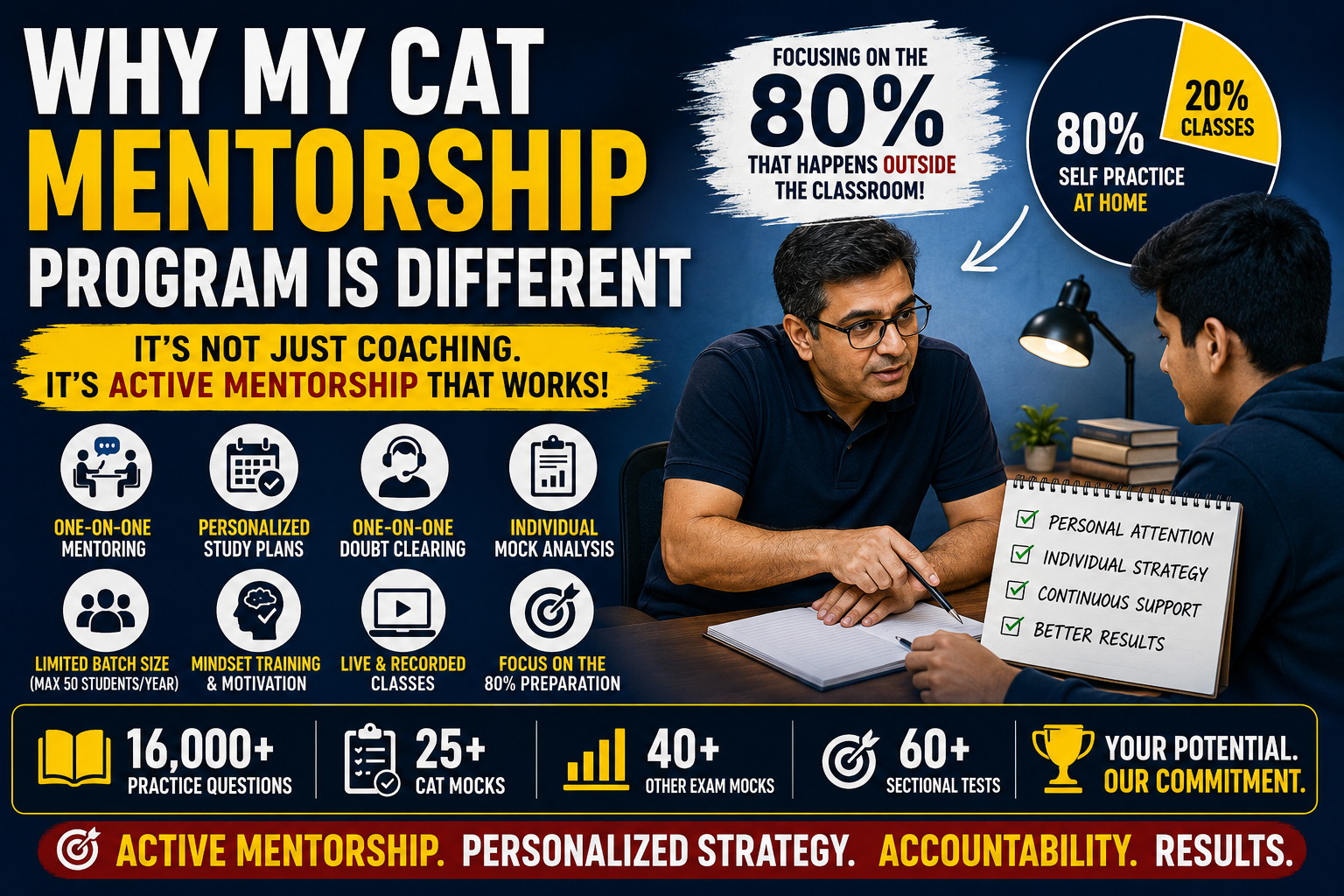
The 80/20 Rule of CAT Preparation
Most CAT coaching programmes provide students with the visible 20% of preparation:
- Classes
- Faculty
- Study material
- Tests
- Mock CATs
But approximately 80% of CAT preparation happens outside the classroom.
It happens when you:
- Solve questions independently
- Complete your study material
- Revise concepts
- Take sectional tests
- Write Mock CATs
- Analyse your mistakes
- Identify your weaknesses
- Improve your test-taking strategy
- Manage your time
- Work on your mindset
- Repeat the process consistently
This 80% is also the hardest part of CAT preparation.
It is easy to attend a class.
It is much harder to sit alone for three hours and work through difficult questions.
It is easy to buy a Mock CAT series.
It is much harder to take every mock seriously and spend several hours analysing it afterwards.
It is easy to create a preparation timetable.
It is much harder to follow it for nine or ten months.
My CAT mentorship programme is designed around this reality.
My focus is not just on the 20% that happens in class.
I am actively involved in the 80% that determines whether you actually succeed.
1. One-on-One Mentoring and Regular Reviews
Every student has a different starting point.
Some students have strong Quant but weak VARC.
Others struggle with DILR.
Some have excellent conceptual knowledge but poor exam strategy.
Some students know what to study but lack consistency.
Others work hard but don’t know whether their preparation is moving in the right direction.
This is why my programme includes fortnightly one-on-one mentoring meetings.
These sessions are used to:
- Review your preparation
- Evaluate your performance
- Identify gaps
- Create realistic study plans
- Set milestones
- Review progress
- Modify schedules when required
The objective is to create structure and discipline.
You don’t have to figure everything out alone.
Your preparation is continuously reviewed and recalibrated based on your actual performance.
2. Personalised CAT Study Plans
There is no universal CAT preparation strategy.
The study plan that works for a student with a 95 percentile starting point may not work for someone starting at 60 percentile.
Similarly, a working professional may require a completely different schedule from a college student.
That is why study plans in my programme are co-created with the student.
We look at:
- Your current level
- Your strengths
- Your weaknesses
- Your available time
- Your preparation history
- Your mock performance
- Your target
- Your learning pace
The objective is not to give you a generic timetable.
The objective is to create a personalised CAT preparation strategy that you can actually execute.
3. One-on-One Doubt Clearing
Doubt clearing is another area where traditional coaching can become impersonal.
In a large classroom, one student’s doubt may not be relevant to another.
Students may also hesitate to ask questions repeatedly.
In my programme, doubt clearing is conducted through live, one-on-one sessions.
The focus is on understanding the student’s exact difficulty.
The goal is not simply to provide an answer.
It is to understand why the student was unable to solve the problem.
Was it a conceptual gap?
A calculation error?
A problem interpretation issue?
A lack of familiarity with the topic?
Or simply an incorrect approach?
Understanding the reason behind the mistake is often more valuable than knowing the answer.
4. Individualised Mock CAT Analysis
Mock tests are among the most important components of CAT preparation.
But simply taking mocks is not enough.
The real learning happens during mock analysis.
After every four Mock CATs, I conduct a one-on-one analysis session with the student.
We examine:
- Which questions were attempted
- Which questions were skipped
- Which questions were incorrectly selected
- Where time was wasted
- Which topics caused difficulty
- Whether the student panicked
- How section-wise decisions were made
- Whether the attempt strategy was effective
Over time, these analyses help develop a personalised CAT exam strategy.
The objective is to ensure that the strategy is not borrowed from someone else.
It is built around your strengths, weaknesses, temperament, and performance patterns.
5. Limited to 50 Students Per Year
Personalisation becomes difficult when the number of students becomes too large.
If a mentor has thousands of students, it is almost impossible to actively monitor the preparation of every individual.
My programme is therefore limited to a maximum of 50 students per year.
This allows me to remain personally involved in the preparation journey of each student.
The objective is simple:
I don’t want to merely teach students. I want to know how each student is preparing.
I want to know:
- Are you following your schedule?
- Are you completing your material?
- Are your mock scores improving?
- Are you repeating the same mistakes?
- Are you losing confidence?
- Are you pushing yourself enough?
This level of involvement is possible only when the number of students is deliberately limited.
6. Personalised CAT Strategy
There is no single “best” CAT strategy.
The right strategy depends on the individual.
One student may need to maximise attempts.
Another may need to focus on accuracy.
Someone may need to become more aggressive.
Someone else may need to become more selective.
A student who panics under pressure may need a completely different approach from someone who remains calm but takes too long to solve questions.
Your strategy evolves through your preparation and mock performance.
That is why personalised mock analysis is such an important part of the programme.
Your strategy is discovered, tested, refined, and strengthened over time.
7. Mindset Training and Panic Management
CAT is not only a test of knowledge.
It is also a test of decision-making under pressure.
You may know how to solve a question and still get it wrong because you panicked.
You may spend five minutes on a question that should have been abandoned after thirty seconds.
You may lose confidence after a difficult DILR set.
You may allow one bad section to affect the next section.
These are not always academic problems.
They are mindset and decision-making problems.
One-on-one mindset training helps students develop the confidence and emotional stability required to handle the pressure of the actual CAT examination.
The goal is to enter CAT with a clear mind and a tested strategy.
8. Live and Recorded CAT Classes
The programme combines recorded and live learning.
Recorded classes are available for foundational concepts, allowing students to learn at their own pace and revisit topics whenever necessary.
Live sessions focus on areas where interaction adds greater value, including:
- Advanced CAT concepts
- Previous CAT papers
- Mock CAT analysis
- Strategy demonstration
- Advanced problem-solving
This approach provides flexibility without compromising on personal interaction.
Students can revisit fundamental concepts when required while using live sessions for higher-level learning and strategic development.
9. A Comprehensive CAT Practice Ecosystem
Personal mentorship is only effective when students also have access to sufficient practice.
The programme provides access to a comprehensive practice ecosystem that includes approximately:
- 16,000 practice questions
- 25 CAT Mock Tests
- 40 Mock Tests for other MBA entrance examinations
- 60 Sectional Tests
The objective is to provide enough practice to develop both conceptual understanding and exam-taking skills.
But again, the emphasis is not simply on completing a large number of questions.
The focus is on using practice intelligently.
Solve.
Analyse.
Identify the gap.
Correct the gap.
Test again.
That is how skills improve.
10. Accountability: The Missing Piece in CAT Preparation
Most students don’t fail CAT because they don’t have enough resources.
They fail because they don’t use the resources consistently.
They start with enthusiasm.
They attend classes.
They buy books.
They take a few tests.
And slowly, the preparation loses momentum.
This is where accountability becomes critical.
Active mentorship creates a system where the student is continuously monitored.
Milestones are established.
Progress is reviewed.
Weaknesses are identified.
Schedules are modified.
Performance is evaluated.
The student is pushed when necessary.
The purpose is not to create pressure for the sake of pressure.
It is to ensure that your preparation matches the level of effort required to reach your goal.
CAT Coaching vs Active CAT Mentorship
Traditional coaching primarily answers:
“What should I study?”
Active mentorship goes further.
It asks:
“What should I study, when should I study it, how much should I study, am I actually doing it, and is it improving my performance?”
That is the difference.
A student can have access to the best CAT books in the country and still fail to crack CAT.
A student can attend classes taught by excellent faculty and still underperform.
A student can take 30 mocks and still repeat the same mistakes.
The missing ingredient is often not information.
It is execution.
Who Is This CAT Mentorship Programme For?
This programme is designed for students who want more than access to study material and classes.
It is particularly suitable for aspirants who:
- Need personalised CAT preparation
- Want one-on-one mentorship
- Struggle with consistency
- Need help developing a CAT exam strategy
- Want detailed mock analysis
- Need accountability
- Have difficulty identifying their preparation gaps
- Want help managing exam pressure
- Are willing to step outside their comfort zone
- Want to maximise their CAT potential
The programme is not built around the idea of simply “finishing the syllabus.”
It is built around helping you become exam-ready.
The Real Difference: I Am Interested in the 80%
The biggest difference between my CAT programme and conventional coaching is simple.
I am interested in what you do after the class ends.
I am interested in the hours you spend alone.
The questions you solve.
The tests you take.
The mistakes you make.
The decisions you take during mocks.
The gaps you ignore.
The days you lose motivation.
The moments when you panic.
The preparation that nobody else sees.
Because that is where CAT is actually won.
The classroom gives you the tools.
Active mentorship ensures that you use them.
My objective is not merely to help you prepare for CAT.
It is to help you build the discipline, skills, strategy, confidence, and mindset required to reach your highest potential.
And that is why my CAT programme is different.
[/vc_column_text][/vc_column][/vc_row]