admin
admin 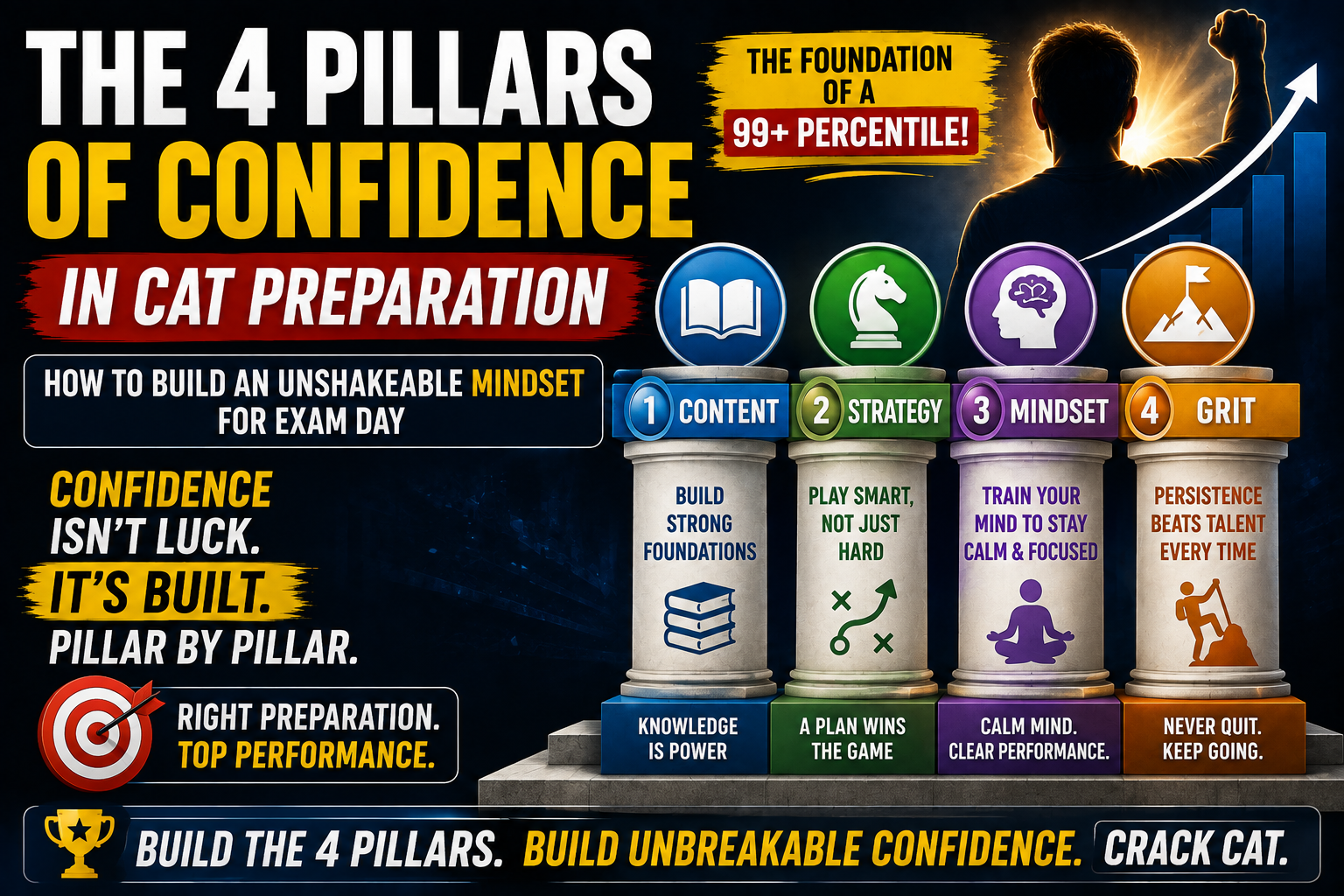
The 4 Pillars of Confidence in CAT Preparation: How to Build an Unshakeable Mindset for Exam Day
Every CAT aspirant wants confidence.
Everyone wants to walk into the exam hall feeling calm, composed, and ready to tackle whatever the paper throws at them.
But here’s the truth that most students overlook:
Confidence isn’t something you can buy, borrow, or fake.
It doesn’t appear overnight. It isn’t created by motivational videos or positive affirmations.
Real confidence is earned.
It is the natural outcome of a preparation process built on four essential pillars—Content, Strategy, Mindset, and Grit. Together, these pillars determine how you perform not only in CAT but in any competitive game.
If you think of CAT as a sport rather than just another exam, these four pillars become the foundation of your success.
Why Confidence Matters in CAT
The CAT is unlike traditional examinations where memorizing information is enough.
On exam day, you have just a few minutes to understand unfamiliar questions, make decisions under pressure, and recover quickly when things don’t go according to plan.
This is exactly what elite athletes do during competition.
The difference between a 95 percentile and a 99 percentile is often not intelligence—it’s the ability to perform under pressure.
Confidence is the master key that unlocks this performance.
But confidence doesn’t come first.
It comes last.
Let’s understand what creates it.
Pillar 1: Build Strong Content Before Anything Else
Every sport begins with learning the fundamentals.
A cricket coach first teaches a player how to defend, drive, cut, pull, and sweep. Without learning the correct technique, years of practice only reinforce bad habits.
CAT preparation is no different.
Before worrying about mock tests or exam strategies, you must build a solid conceptual foundation.
For Quantitative Aptitude, that means understanding topics such as:
- Arithmetic
- Algebra
- Geometry
- Number Systems
- Modern Mathematics
If you don’t understand concepts like geometry theorems or algebraic relationships, no shortcut or exam strategy can compensate.
Similarly, VARC requires strong reading comprehension and critical reasoning, while LRDI requires familiarity with logical structures and problem-solving frameworks.
Content is king.
Without knowledge, strategy becomes meaningless.
Without concepts, confidence becomes an illusion.
The first responsibility of every CAT aspirant is to master the basics.
Pillar 2: Develop a Winning CAT Strategy
Imagine three legendary cricketers walking out to bat:
- Virender Sehwag
- Rahul Dravid
- Sachin Tendulkar
All three were extraordinary batsmen.
Yet none of them approached an innings in exactly the same way.
Each had a strategy suited to his strengths.
Sehwag attacked.
Dravid accumulated patiently.
Sachin adapted according to the situation.
Different approaches.
Same objective.
The same principle applies to CAT.
Every candidate needs a personalized strategy that answers questions like:
- Which section should I attack first?
- How much time should I spend on each question?
- When should I skip a difficult problem?
- How do I identify easy questions quickly?
- When should I move on instead of getting stuck?
Many students believe strategy is simply maximizing marks.
In reality, strategy is about maximizing performance under pressure.
An effective CAT strategy prepares you for situations where things go wrong.
You may enter a difficult Reading Comprehension passage.
You may spend ten minutes on an impossible LRDI set.
You may make a careless calculation error in Quant.
These situations are inevitable.
A good strategy doesn’t assume perfection.
It assumes mistakes will happen—and provides a recovery plan.
That is what separates experienced test-takers from anxious ones.
Pillar 3: Develop the Right Mindset for CAT
This is perhaps the most underestimated aspect of CAT preparation.
Most aspirants spend months preparing concepts.
Some invest time in strategy.
Very few prepare their minds.
Here’s an uncomfortable reality.
Every year, thousands of students perform brilliantly in Mock CATs but underperform in the actual CAT examination.
Why?
Not because they forgot concepts.
Not because their strategy was wrong.
They simply couldn’t execute their strategy under pressure.
A strategy written on paper is worthless if panic takes over on exam day.
The CAT examination is emotionally different from a mock test.
During mocks:
- You know another mock is coming next week.
- There are no real consequences.
- Mistakes are easier to accept.
On CAT day:
- You know the exam comes only once a year.
- Every decision feels irreversible.
- Anxiety magnifies every mistake.
Suppose you spend fifteen minutes on the wrong LRDI set.
What happens next?
Many students panic.
They start rushing.
Accuracy drops.
Confidence disappears.
One mistake snowballs into several more.
Students often believe their percentile was ruined by that one difficult set.
In reality, it was ruined by the panic that followed.
This is where mindset matters.
A strong mindset allows you to accept mistakes quickly, recover emotionally, and return your focus to the next question.
Professional athletes train this ability every day.
A batsman may edge the first few deliveries.
A tennis player may lose the first set.
An Olympic shooter may miss an early shot.
Yet they recover because they understand one simple principle:
You cannot control what has happened. You can only control the next moment.
CAT demands exactly the same mental discipline.
Pillar 4: Grit—The Quality That Keeps You Going
Every successful athlete has one thing in common.
Failure.
Nobody reaches the top without repeatedly experiencing setbacks.
At every stage of their careers, athletes lose matches, suffer injuries, endure criticism, and face disappointments.
Yet they continue improving.
That quality is called grit.
Psychologist Angela Duckworth defines grit as passion and perseverance toward long-term goals.
For CAT aspirants, grit means continuing to improve despite disappointing mock scores.
Every student preparing seriously for CAT will experience failure.
A bad mock test.
A poor percentile.
An impossible LRDI section.
A week where nothing seems to improve.
These moments are not signs that you’re incapable.
They are part of the learning process.
The question is not whether you’ll fail.
The question is how you’ll respond.
Growth Mindset vs Fixed Mindset in CAT Preparation
Carol Dweck’s research on Growth Mindset provides one of the most important lessons for CAT aspirants.
Students with a fixed mindset often respond to poor mock scores by blaming external factors.
They blame:
- The coaching institute
- The paper difficulty
- Lack of time
- Their job
- The computer
- The mock platform
In other words, they search for reasons outside themselves.
This prevents growth.
Students with a growth mindset respond differently.
They ask:
- Why did I miss this question?
- Which concept needs improvement?
- Was my strategy wrong?
- What pattern am I repeatedly missing?
- How can I improve before the next mock?
They treat every failure as valuable feedback.
They actually want problems to appear during preparation because solving those problems makes them stronger before the real CAT.
Would you rather discover your weaknesses in August or on CAT day?
The answer is obvious.
Failures during preparation are gifts.
Failures on exam day are expensive.
Why M.S. Dhoni Represents the Ideal CAT Mindset
Few sportspersons demonstrate grit better than M.S. Dhoni.
Throughout his career, Dhoni built a reputation for remaining calm under immense pressure.
He wasn’t always the most naturally gifted player on the field.
Yet he repeatedly finished matches that seemed impossible to win.
Why?
Because he focused on execution instead of emotion.
He treated pressure as part of the game.
CAT preparation requires the same approach.
Stay calm.
Trust your preparation.
Play one question at a time.
Recover quickly after mistakes.
That mindset wins exams.
Confidence Is the Outcome, Not the Starting Point
Many students think confidence is simply a positive attitude.
It isn’t.
Ask yourself honestly.
Would you feel confident if you hadn’t completed the syllabus?
Would you feel confident if you had never written a mock test?
Would you feel confident without a clear exam strategy?
Probably not.
You might appear confident in front of friends.
Deep inside, you’d still be uncertain.
Real confidence comes from preparation.
It comes from knowing:
- You understand the concepts.
- You have practiced extensively.
- You have tested your strategy.
- You have recovered from failures before.
- You know how to remain calm under pressure.
Confidence is not blind optimism.
It is evidence-based self-belief.
Learn from Failure Instead of Running Away
Indian cricket has seen countless talented players.
One of the most gifted was Vinod Kambli.
His career began brilliantly.
But when he encountered serious challenges against high-quality fast bowling, his confidence collapsed.
Unfortunately, he never fully recovered.
Talent alone wasn’t enough.
Mental resilience mattered more.
Now compare that with players who repeatedly bounced back from setbacks.
Their confidence wasn’t built only through success.
It was built through overcoming failure.
The same lesson applies to CAT.
Your mock test scores will fluctuate.
Some weeks you’ll improve dramatically.
Some weeks you’ll struggle.
Don’t measure your preparation by one mock test.
Measure it by your ability to learn from every mock.
Final Thoughts: Build Confidence the Right Way
Every mock test, every mistake, every difficult question and every disappointing score is preparing you for one purpose—to become stronger on CAT day.
Don’t chase confidence directly.
Instead, focus on building the four pillars that create it:
- Content to build knowledge.
- Strategy to maximize performance.
- Mindset to execute under pressure.
- Grit to keep improving despite setbacks.
When these four pillars become strong, confidence follows naturally.
Walk into the CAT examination hall with a quiet belief—not because you expect the paper to be easy, but because you know you’ve prepared yourself to handle whatever comes your way.
That is the confidence that wins games.
And that is the confidence that cracks CAT.