 admin
admin July 2019. Four months to CAT.
My son, who had completed his BA in English, came to me one day and said something that immediately caught my attention.
He wanted to crack CAT.
I asked him a simple question: “What colleges are you targeting?”
His answer came without hesitation.
“The top 10.”
I smiled.
Perhaps he did not fully understand the enormity of the task he had just set for himself.
There was one small problem.
He had already attempted CAT in 2018 and scored around the 70 percentile. He was not someone I would describe as an extraordinary student who could effortlessly crack the CAT exam with a few months of preparation.
And now, with just four months remaining, he wanted to target the best B-schools in India.
It was an ambitious goal.
But ambition, by itself, is not enough to crack CAT.
You need the right preparation strategy, consistent hard work, discipline, the ability to analyse your mistakes and, most importantly, the resilience to continue when things don’t go according to plan.
That conversation with my son eventually changed the direction of my life.
His next question was predictable.
“When should I join T.I.M.E.?”
He asked about T.I.M.E. because I had been associated with the organisation for nearly 18 years. During those years, I had trained thousands of CAT aspirants, with many of them eventually making it to the top B-schools in India.
I had personally cracked CAT multiple times, with my best percentile being 99.85.
So, I knew something about the CAT preparation process.
I knew the importance of fundamentals.
I knew how CAT worked.
I knew how students behaved during a long preparation journey.
And, perhaps most importantly, I knew that the same preparation model does not work equally well for every student.
So, I told him something that he probably did not expect to hear from me.
“T.I.M.E. is a good coaching institute. But I don’t think it is the right choice for you.”
My reasoning was simple.
A large coaching institute has thousands of students. It has excellent faculty, study material, mock tests and a structured programme.
But a student who is struggling needs something more.
He needs someone to notice when he is falling behind.
He needs someone to understand why his mock scores are not improving.
He needs someone to identify whether the problem is knowledge, speed, accuracy, question selection or exam strategy.
He needs someone to tell him what to do next.
I was worried that my son could get lost in a large classroom environment.
With only four months left for CAT, I felt that he could easily become demoralised after a few difficult classes and disappointing mock scores.
I told him honestly that if he followed a conventional coaching route, I did not see him going much beyond the 85 to 90 percentile range in the limited time available.
But I also knew that he had potential that was not being utilised.
He needed a different approach.
The Most Difficult Decision
At that point, I faced a difficult decision.
I had already moved away from CAT coaching about a year earlier.
I was enjoying my life.
I had my farming, cricket, business coaching and travelling.
I had no immediate plans to return to CAT preparation.
But here was my own son, asking me to help him achieve something that seemed, at first glance, almost impossible.
I was also aware of the risks.
If I took responsibility for his CAT preparation and he failed, he could lose an entire year.
He could end up joining a B-school far below his potential.
The emotionally safe decision would have been to tell him to join one of the large coaching institutes.
If he succeeded, everything would be fine.
If he failed, nobody could blame me.
But I knew that the safer option was not necessarily the better option.
I knew that he needed individual attention.
He needed a personalised CAT preparation plan.
And I knew I could provide that.
So I gave him a choice.
I told him:
“If you want me to mentor you, you have to follow the plan completely. You will need an individualised preparation strategy, a stage-wise material plan, a personalised daily, weekly and monthly schedule and continuous mentoring.”
I also warned him about what lay ahead.
Things would not always go smoothly.
There would be bad mock scores.
There would be silly mistakes.
There would be days when he would question his own ability.
There would be fatigue, frustration and moments of self-doubt.
Things might even get worse before they got better.
If he wanted to target the top B-schools, he would need emotional strength as well as academic preparation.
And I would be there to help him through all of it.
But he had to make one commitment.
He had to stick to the plan.
No matter how bad the mock score was.
No matter how tired he felt.
No matter how difficult the preparation became.
He agreed.
And that was the beginning.
The CAT Preparation Journey
We did not reinvent the wheel.
There was already enough high-quality CAT preparation material available.
He joined a couple of mock test series.
I took responsibility for his classes and, more importantly, his overall preparation.
We created a structured plan.
We divided the preparation into stages.
We identified gaps.
We worked on his weak areas.
We created schedules.
We analysed mock tests.
We discussed his mistakes.
We worked on question selection and exam strategy.
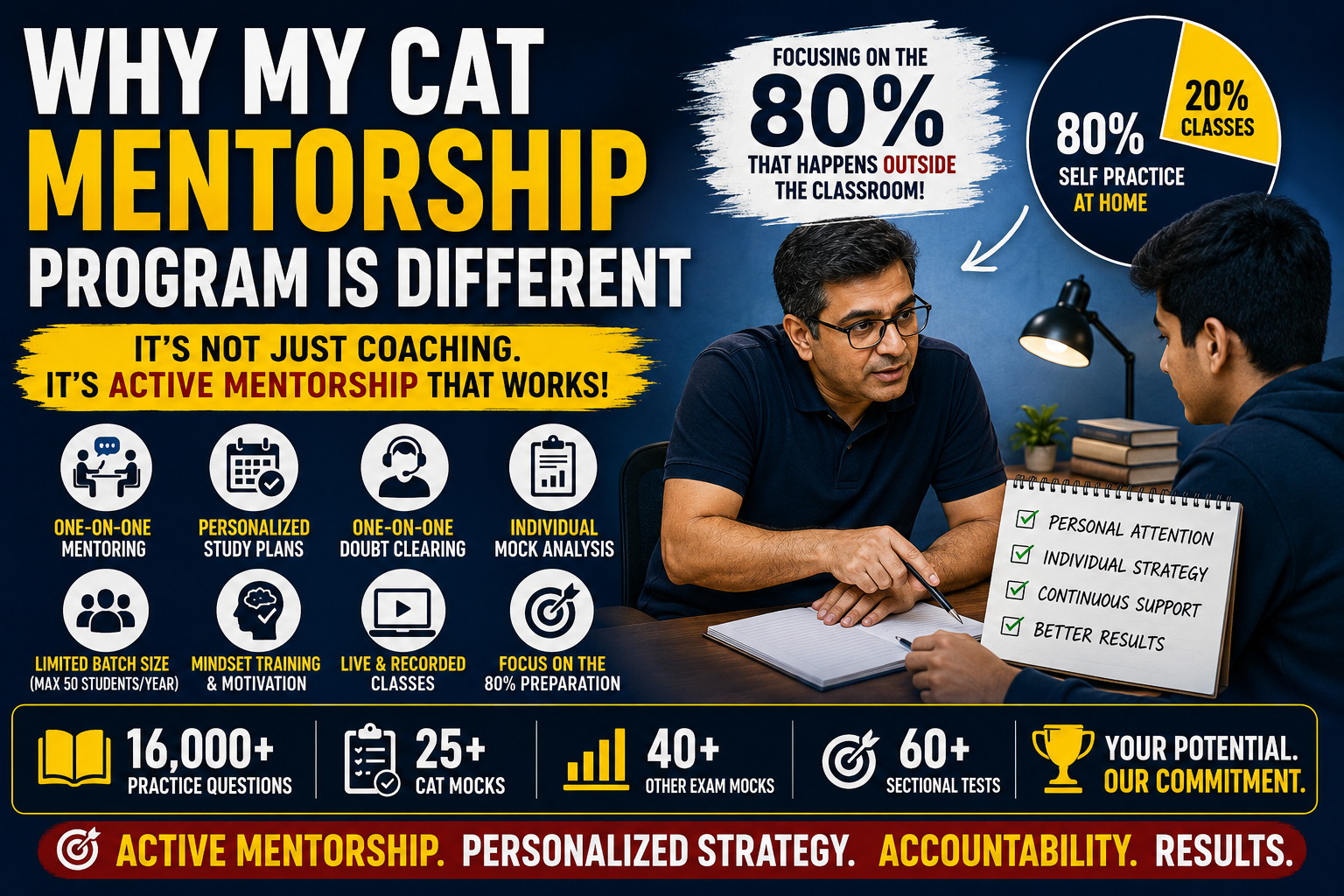
Most importantly, I monitored the 80% of CAT preparation that happens outside the classroom.
That is where the real preparation takes place.
The journey was not easy.
By the end of August, he started touching the 85 percentile range.
By the end of September, he crossed the 90 percentile mark for the first time.
For someone who had scored around the 70 percentile in his previous CAT attempt, this was encouraging.
But CAT preparation is rarely a smooth upward graph.
There were plenty of setbacks.
There were disappointing mock scores.
There were silly mistakes.
There were problems with speed.
Sometimes, he could not identify the easy questions.
At other times, fatigue took over.
There were moments when he felt depressed and wondered whether he was actually capable of achieving his goal.
And then there was another unique problem.
His mentor was his father.
How many students would genuinely want their father to mentor them for CAT?
Probably not many!
There were times when our mentoring sessions became arguments.
There were times when he did not want to listen.
There were times when I had to push him harder than he wanted.
But slowly, something changed.
His scores started improving.
He began to trust the process.
And eventually, he began to trust me as his mentor.
The Result
The hard work eventually paid off.
He scored 144 marks and achieved a 98.1 percentile in CAT.
He also received interview calls, including one from IIM Ahmedabad. He finally joined MDI Gurgaon.
But the most important outcome for me was not just his percentile.
It was what happened next.
Some of his friends started asking him whether I could help them prepare for CAT.
Could I mentor them?
Could I help them build a strategy?
Could I guide them through their preparation?
My son was surprisingly insistent that I should start mentoring other students.
That made me stop and think.
I had spent nearly 18 years in CAT training.
I had trained thousands of aspirants.
I had seen students struggle, improve, succeed and sometimes fail because they lacked the right direction.
I realised that I genuinely missed teaching.
I missed interacting with young, ambitious people.
I missed being part of their journey.
Perhaps there was still something I could contribute.
But I also knew that I did not want to return to the traditional coaching model.
I did not want thousands of students.
I did not want to simply provide classes and study material.
I wanted to work closely with students.
I wanted to understand their individual strengths and weaknesses.
I wanted to be involved in the 80% of CAT preparation that happens outside the classroom.
I wanted to analyse their mock tests.
I wanted to help them build personalised strategies.
I wanted to help them handle the pressure of CAT day.
Most importantly, I wanted to ensure that serious students did not get lost in a large crowd.
So, I decided to set myself a limit.
A maximum of 40 students a year.
The number was deliberately small.
I wanted to personally know every student.
I wanted to understand their preparation.
I wanted to monitor their progress.
I wanted to push them when they became comfortable.
I wanted to support them when things went wrong.
I wanted to ensure that every student received the personal attention that I believed was missing from conventional coaching.
And that was how my second innings in CAT preparation began.
The Birth of CAT Mentorship
What started as an attempt to help my son eventually became the foundation of CAT Mentorship.
The philosophy was simple.
CAT preparation is not only about learning concepts.
It is about converting knowledge into performance.
It is about consistency.
It is about discipline.
It is about mock analysis.
It is about decision-making.
It is about building an exam strategy.
It is about staying calm when the pressure is at its highest.
And it is about having someone who can see what you may not be able to see yourself.
My son’s journey reinforced one belief that has stayed with me ever since:
Every CAT aspirant is different. Therefore, every CAT preparation journey should be different.
Some students need classes.
Some need only mock tests.
Some need help with fundamentals.
Some need a personalised CAT strategy.
Some need accountability.
Some need someone to push them beyond their comfort zone.
And some simply need someone to believe in their potential when they themselves begin to doubt it.
That is the philosophy behind my CAT mentorship programme today.
It is not about promising shortcuts.
It is not about claiming that mentorship can replace hard work.
In fact, it is the opposite.
The student still has to do the hard work.
My role is to ensure that the hard work is directed towards the right goals, at the right time, with the right strategy.
Because ultimately, CAT is not just about getting a percentile.
It is about finding your highest potential.
And sometimes, the difference between where you are and where you could be is not more information.
It is the right direction, the right strategy and someone who stays with you throughout the journey.
That is why I returned to CAT preparation.
That is why I chose to work with only a limited number of serious aspirants every year.
And that is how CAT Mentorship was born. Thanks to my son.
[/vc_column_text][/vc_column][/vc_row]


Related Articles
 CAT Mentoring
⏱ 10 min
CAT Mentoring
⏱ 10 min
How Is My CAT Mentorship Programme Different? The Power of Active Mentorship
Choosing the right CAT coaching programme can be one of the most important decisions you make…
 CAT Coaching
⏱ 7 min
CAT Coaching
⏱ 7 min
How Many Hours Should You Study for CAT? Think Like an MBA, Not an Aspirant
How Many Hours Should You Study for CAT? Think Like an MBA, Not an Aspirant The…
 CAT Mentoring
⏱ 6 min
CAT Mentoring
⏱ 6 min
Why CAT Is a Game, Not Just an Exam: The Skill-Based Mindset That Helps You Score 99+ Percentile
Why CAT Is a Game, Not Just an Exam: The Skill-Based Mindset That Helps You…